WP-1420.1 – LETO (Lunar Earth Temperature Observatory) -MERIDIAN (Moon EaRth leto vIsibility and raDIative trANsfer)
Overview
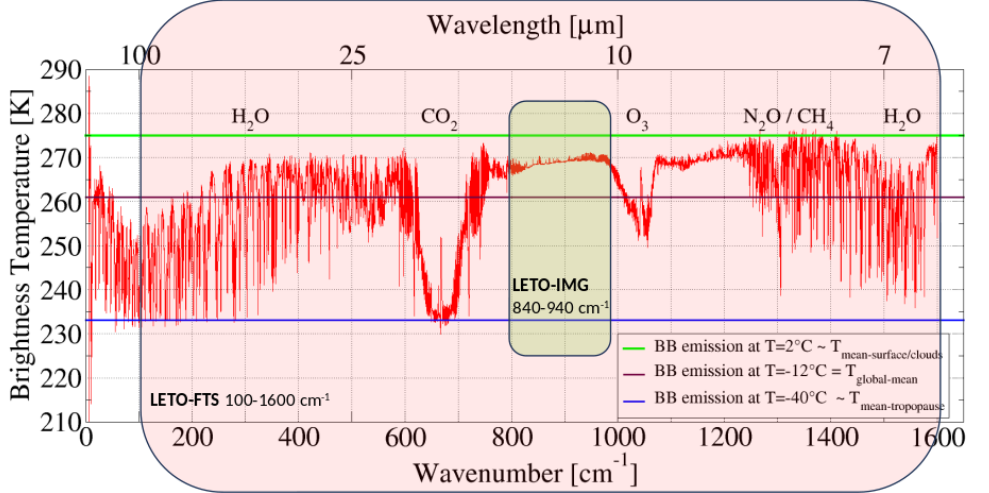
LETO (Lunar Earth Temperature Observatory) is an Earth observation system developed by CNR-INO within the EMM infrastructure. It comprises two instruments: a Fourier-transform spectroradiometer (LETO-FTS) and an imager (LETO-IMG), designed to continuously monitor the brightness temperature and outgoing longwave radiation flux of the full Earth disk as seen from the lunar surface.
Instrument Specification
LETO-FTS operates in the spectral range ~100–1600 cm⁻¹ (6–100 μm), with spectral resolution better than 0.5 cm⁻¹ and temporal resolution of a few minutes. LETO-IMG identifies thermal anomalies — such as large-scale fires or volcanic eruptions — that could bias the mean temperature measured by the spectrometer. Both instruments are conceptually related to sensors developed for the ESA Earth Explorer 9 mission FORUM (FORUM mission site).
Earth Visibility from the Lunar Site — Orbital Simulator
Theoretical Framework
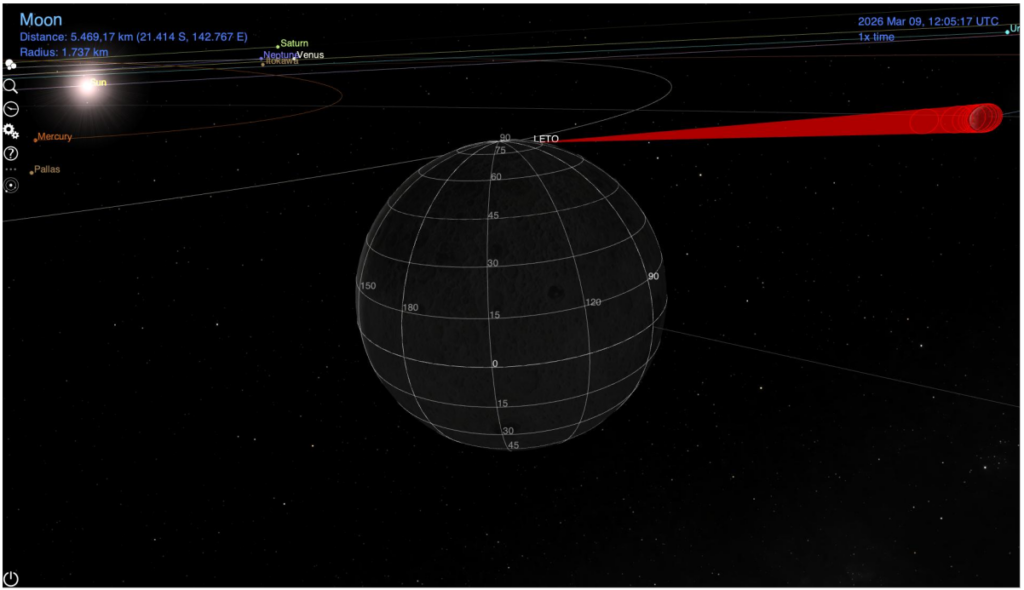
The fraction of the Earth disk visible from any point on the lunar surface depends on the three-body dynamics of the Sun–Earth–Moon system. A theoretical study of this orbital geometry led to the development of a dedicated simulator, enabling systematic evaluation of how the landing-site coordinates on the Moon affect the percentage of visible Earth disk — and therefore the scientific return of LETO.
MERIDIAN is the software tool implementing this simulation, developed internally at CNR-INO (Florence). It integrates the SPICE libraries (NAIF/JPL) for precise celestial ephemerides, computing Earth elevation and azimuth in a topocentric reference frame and incorporating lunar orography through altimetric data from the LOLA instrument aboard NASA’s LRO (2009).
Radiative Transfer
The forward radiative transfer model used in MERIDIAN is sigma-FORUM, a fast parametrised model (Masiello et al., Journal of Quantitative Spectroscopy & Radiative Transfer 312, 2024, 108814) capable of simulating the full atmospheric spectrum between 10 and 2760 cm⁻¹. For each pixel in the visibility grid, atmospheric and surface parameters are extracted from the ERA5 and Huang 2016 databases. sigma-FORUM computes the spectral radiance for each pixel along the line of sight from the lunar site, using the zenith angle relative to the outgoing surface normal. The radiance of each pixel, weighted by the cosine of the zenith angle, is then integrated over the full visible disk.
LETO-FTS — Prototype / Engineering Model
Description
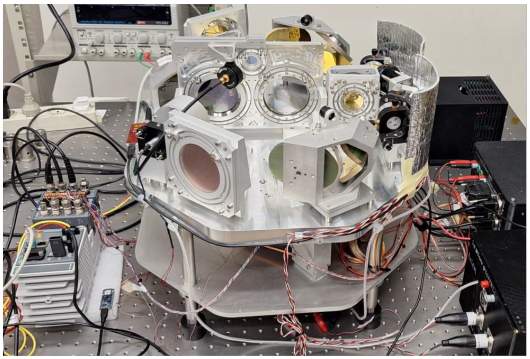
LETO-FTS is a Fourier-transform spectrometer for measuring the mid- and far-infrared spectral flux emitted by the entire Earth disk visible from a future lunar base. The Engineering Model was designed and built by Pecchioli Research Srl at TRL 4. Intended applications include continuous monitoring of the spectrally resolved outgoing flux of the full Earth disk, brightness temperature retrieval across multiple infrared spectral windows, and long-term climate trend analysis. Remote control is provided via a LabVIEW interface.
Key Specifications
- Spectral range: 6–100 μm (100–1600 cm⁻¹)
- Spectral resolution: > 0.5 cm⁻¹
- High thermal stability; temporal resolution of a few minutes
- Remote control via LabVIEW interface
- Integrated high-accuracy calibration unit
Main Optical Components
- Signal input: folding mirror
- Beam splitter
- Rotating mirror (scene selector)
- Fixed mirror
- Internal blackbody source
- Detectors
- Translating mirror
- Blackbodies
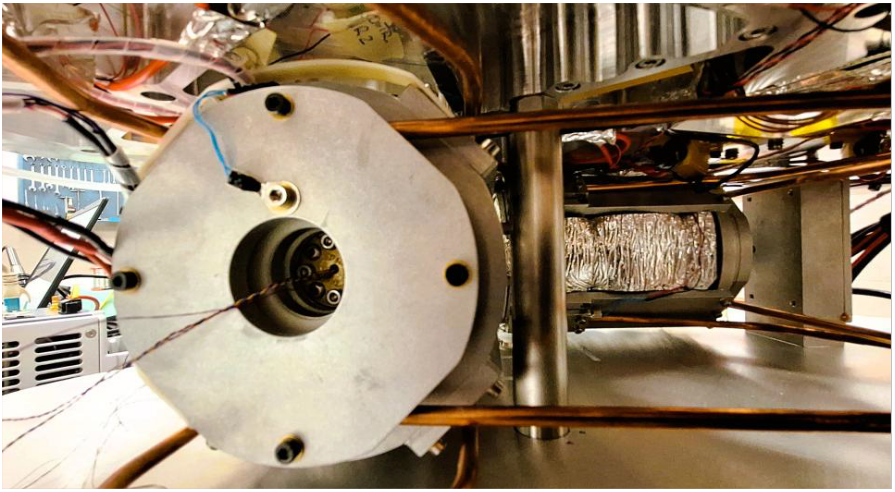
High-Accuracy Calibration Unit
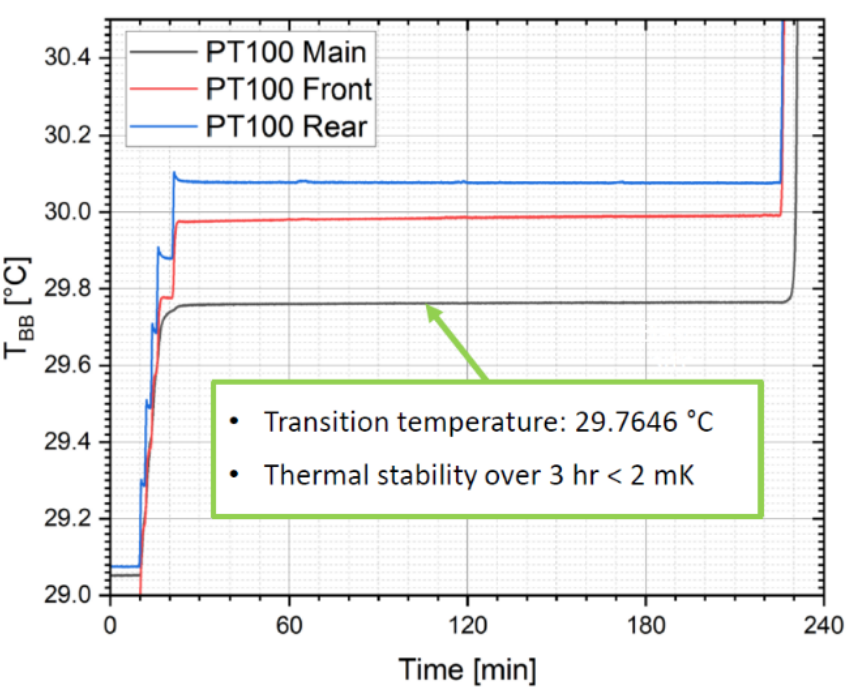
The calibration unit comprises two blackbody sources with emissivity > 0.999 across the 6–100 μm range, providing an absolute temperature accuracy of 0.1 K traceable to SI international standards. Traceability is ensured through a Gallium fixed-point cell developed by INRiM – Physical Thermodynamics, housed in the central section of each blackbody unit to allow in-situ recalibration of the primary thermometers. The full calibration chain is referenced to the International Temperature Scale (ITS-90), guaranteeing accuracy, stability, and reproducibility in field conditions.
MERIDIAN — Moon EaRth leto vIsibility and raDIative trANsfer
MERIDIAN is a web-based tool for the integrated simulation of lunar visibility and radiative transfer from the Earth disk toward the LETO observation site in the infrared band of interest, made available to the EMM research community through a dedicated interface. Developed at CNR-INO (Florence) implementing SPICE (NAIF/JPL) functions in C within a MATLAB environment, it performs ray-tracing-based visibility calculations on a grid wrapping the Earth’s atmosphere, evaluating both full and partial disk visibility. For each visible sector, sigma-FORUM computes the spectral radiance accounting for viewing angle, surface type, and multiple cloud scattering (ice and liquid phases). Atmospheric and surface input parameters are drawn from ERA5 (ECMWF), CMIP6, and the Huang et al. (2016) database for spectral soil emissivity up to the far infrared. The final output is a radiance-weighted angular integration over the visible disk; MERIDIAN also supports the construction and distribution of radiance databases for the research community.
WP-1420.2 – Millimeter-Wave and Sub-THz Laboratory for Earth Observation and Space Science (MaTEO)
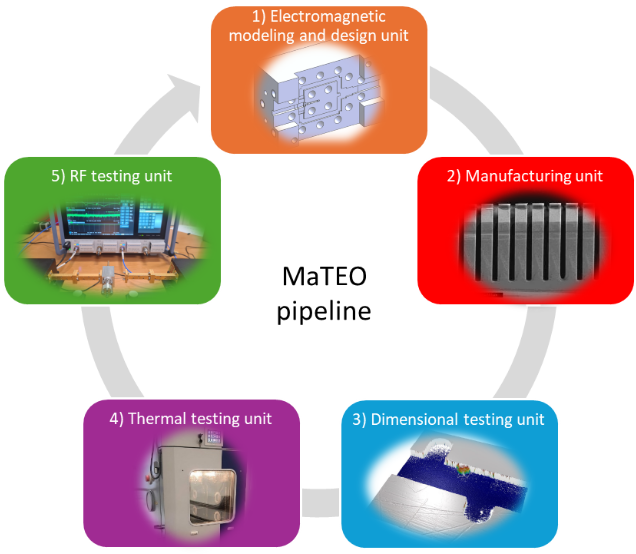
The EMM infrastructure module “Millimeter-Wave and Sub-THz Laboratory for Earth Observation and Space Science (MaTEO)”, established at CNR-IEIIT (https://www.ieiit.cnr.it/), fits within the context of European and international programs for Earth Observation and Space Science from lunar bases, as well as future planetary exploration missions. Recent international missions already envisage the use of radiometric sensors operating on the Moon in the millimeter-wave and sub-THz range (90–900 GHz). In this context, the MaTEO component of the EMM research infrastructure comprises five main functional units forming a complete pipeline for research and development activities on sub-THz technologies, on-ground instruments, and satellite payloads.
Electromagnetic Modeling and Design Unit
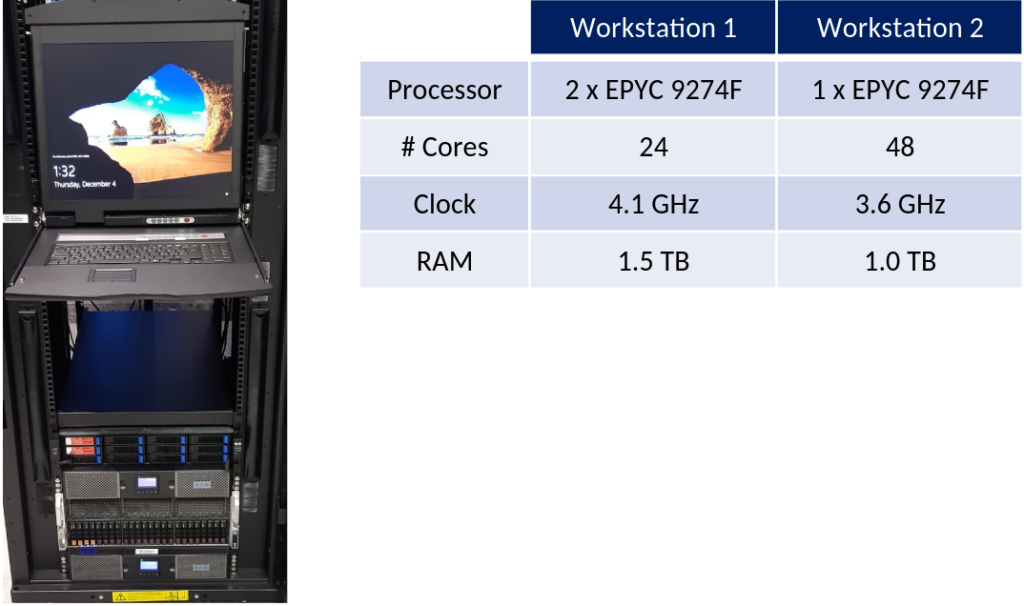
The EMM-MaTEO laboratory is equipped with scientific software for fast and accurate simulation and design of high-frequency devices, including antennas, waveguide and planar components, electromagnetically large scattering objects, and quasi-periodic surfaces. Additional capabilities cover the design and analysis of static and low-frequency applications, printed circuit boards and electronic packages, thermal and mechanical multi-physical analysis, and RF breakdown analysis. Simulation solvers operating in both time and frequency domains run on high-performance workstations with GPU acceleration.
Manufacturing Unit
Two manufacturing routes are available for research activities on sub-millimeter-wave passive devices.
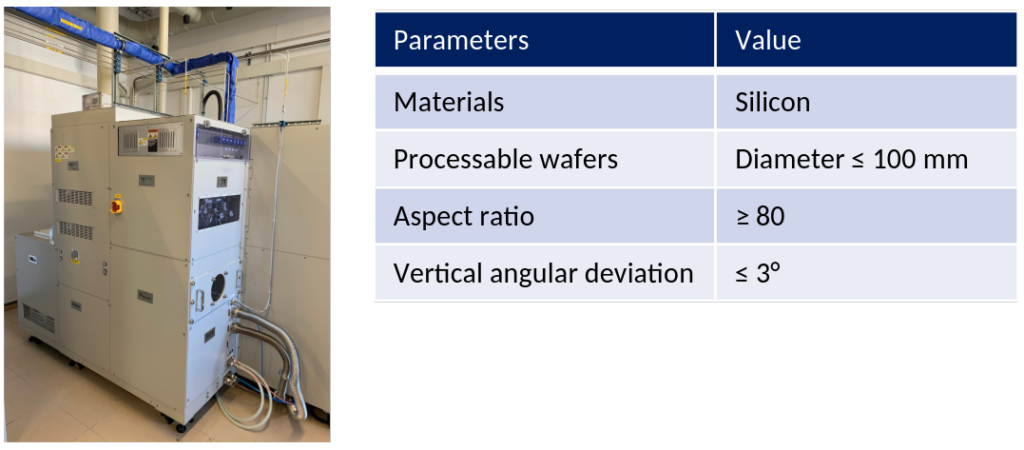
The first is silicon micromachining of silicon wafers (up to 100 mm) through Deep Reactive Ion Etching (S-DRIE) based on the Bosch process. The S-DRIE system features a reaction chamber, a temperature-controlled electrode, and a high-flow exhaust system, enabling stable, high-volume production of high-aspect-ratio parts with micrometric accuracy.
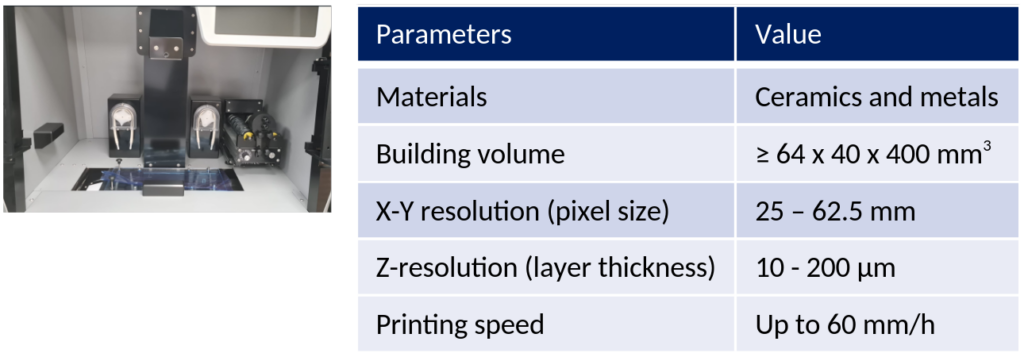
The second is digital light processing (DLP) of ceramics (e.g., alumina, zirconia) and metals (e.g., copper, steels), based on a foil system in which a viscous ceramic slurry is spread over a conveying foil that rolls across the printing area. This process delivers smooth layering for every layer, yielding high-resolution parts with complex geometries and smooth surfaces. All process parameters can be customized for material research activities. This route is operated in collaboration with CNR-STIIMA.
Dimensional Testing Unit
The EMM-MaTEO laboratory provides two instruments for dimensional testing of RF components.
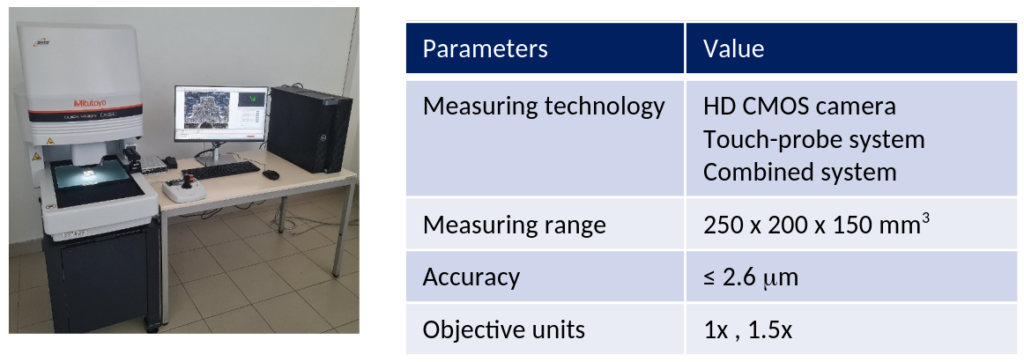
The first is a combined CNC/vision system for accurate dimensional measurements of complex parts, augmented with 2D profile analysis software for straightforward design verification.
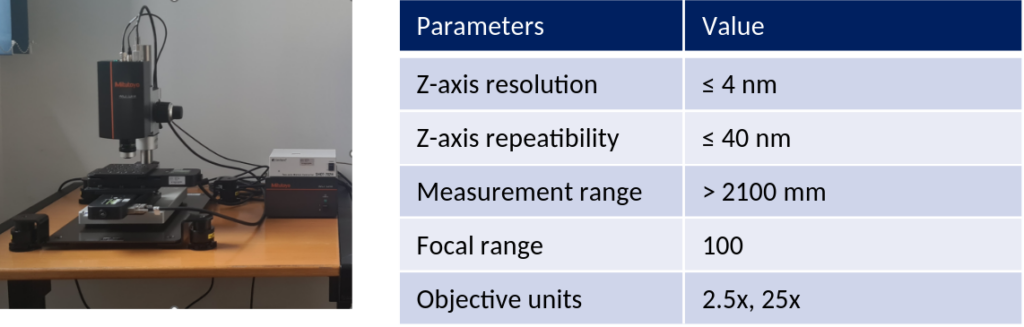
The second is a white-light interferometric instrument for non-contact, high-accuracy surface-shape analysis, including 3D shape measurement and roughness measurement at nanoscale levels.
Thermal Testing Unit
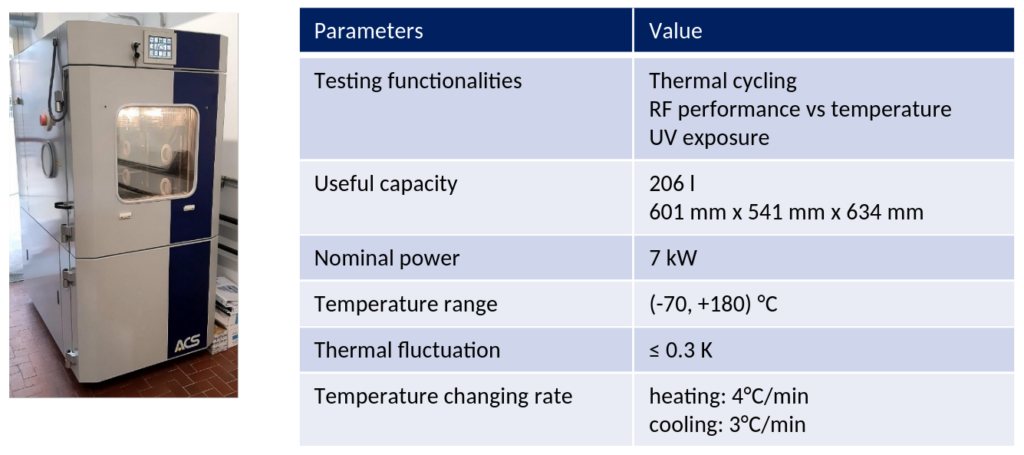
RF performance versus temperature is tested for components and sub-systems with dimensions up to 60 × 54 × 63 cm³ in a climatic chamber operating from -70 °C to +180 °C. The chamber is equipped with pass-through walls for RF cable access and with temperature monitoring sensors mountable on devices under test.
Functionalities: thermal cycling, RF performance vs. temperature, UV exposure. Useful capacity: 206 l (601 × 541 × 634 mm). Nominal power: 7 kW. Temperature range: (-70, +180) °C. Thermal fluctuation: ≤ 0.3 K. Temperature changing rate: heating 4 °C/min, cooling 3 °C/min.
Radio-Frequency Testing Unit
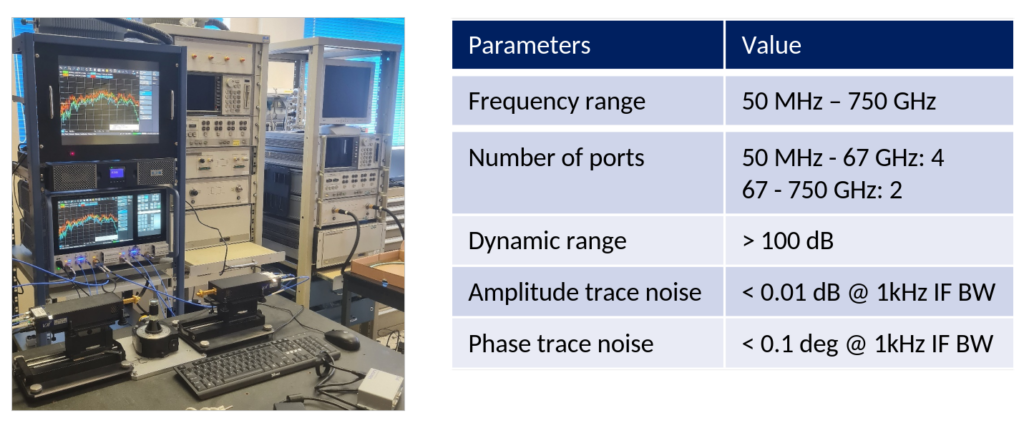
Scattering coefficients and radiation patterns of RF components and sub-systems are measured using high-performance two- and four-port Vector Network Analyzers (VNAs) operating up to 67 GHz. The measurement frequency range is extended up to 750 GHz by connecting the VNAs to waveguide Rx/Tx extenders. Coaxial and waveguide accessories — including adapters, twists, bends, standard horn antennas, matched loads, and LNAs — are available for measurement setups from a few GHz up to 750 GHz.
The EMM-MaTEO laboratory is also equipped with a high-performance signal and spectrum analyzer featuring low phase noise and wide analysis bandwidth (2 GHz), for characterization of wideband components and communication systems based on modulated or frequency-agile signals.